How to Build a 6-Week USMLE Step 1 Study Schedule
A six-week Step 1 study schedule can work as a framework when you have time for practice, review, and regular reassessment. Start with the hours you can actually protect each week, set aside time to review errors, and adjust the plan as your results come in.
One way to structure six weeks
- Establish a baseline in week 1. Try a mixed Qbank block and review the official content outline. Set two review priorities based on the mistakes you see.
- Review weak systems in week 2. Pair focused blocks with short content review. Revisit the same concepts later in the week with different questions.
- Add timed mixed sets in week 3. Pick a pace you can sustain. In your error log, separate timing issues from knowledge gaps and reading errors.
- Reassess in week 4. Use an official NBME self-assessment if it fits your preparation plan. Read the content breakdown and make room for the areas that still need work.
- Practice switching topics in week 5. Combine timed blocks, targeted follow-up, and review of recurring misses. Run the official interactive testing experience.
- Consolidate in week 6. Review the errors that keep repeating, prepare your documents, and practice your break plan. Use recent assessment results and your circumstances to inform decisions about your test date.
A two-hour session you can repeat
Try 30 minutes of questions, 60 minutes of review, 20 minutes of flashcards or retrieval practice, and 10 minutes to choose the next task. If review keeps running over, reduce the next block until you can explain your most important misses. Keep a catch-up slot each week for unfinished work.
Build the schedule you will actually follow
Suppose you can study for two hours on Monday, Wednesday, Friday, and Saturday, plus an hour on Sunday. That is nine hours. Put fresh questions on two days and targeted review on the third. Use Saturday for an uninterrupted timed set with review. Leave Sunday for a brief comparison with last week and use any remaining time for one missed session. Reserve a longer window in the weeks when you plan a full self-assessment.
Write one measurable outcome per session. For example, “finish 20 fresh questions, log the two recurring error patterns, and pick one for Monday.” If a session produces a long list of weak topics, pick the one that appeared in the most fresh questions and the one that costs the most time. Give each a separate practice task.
Update the plan after your checkpoint
Take two weeks with the same kinds of blocks and compare like with like. Suppose you miss five of ten renal questions in week one and two of ten fresh renal questions in week two, with both sets timed. Keep one light renal review session and move the longer slot to a topic that is still weak. If your later questions were from an easier or familiar set, collect another comparable sample first.
Use an official NBME report and recent fresh practice when considering your test date. Check the official instructions for changes to your appointment before making a decision based on a date or eligibility window.
Put the plan on a calendar
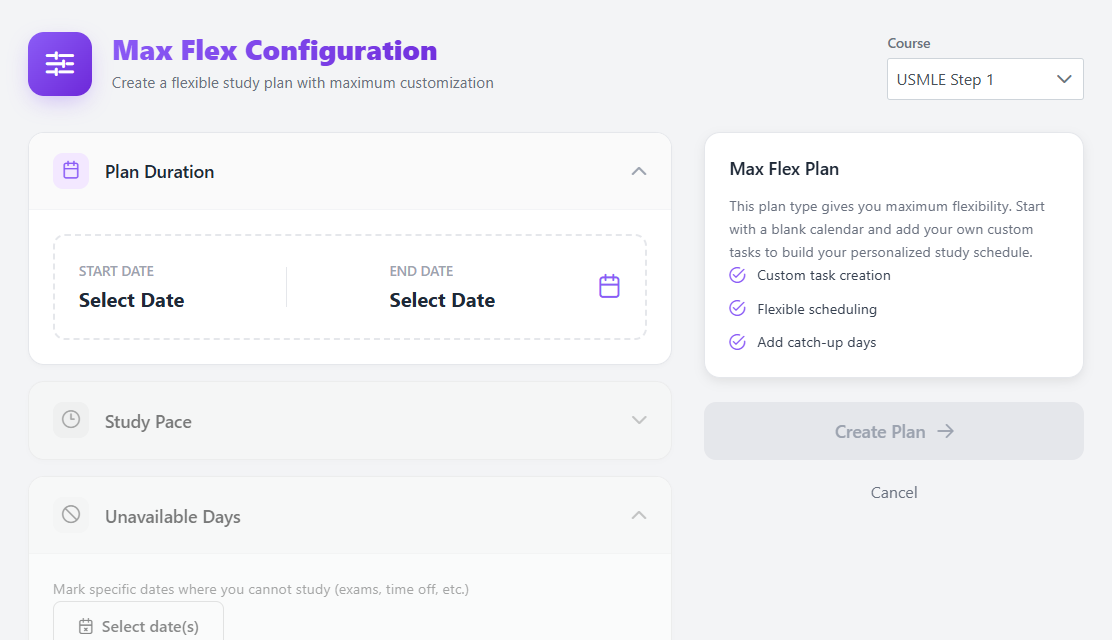
In Fighter’s Study Planner, start with your exam date and availability. Add blocks, review sessions, and flashcards as separate tasks so you can see how much work each day actually holds.
For assessment planning, see when to use an NBME and the official practice questions and the official Step 1 practice materials.